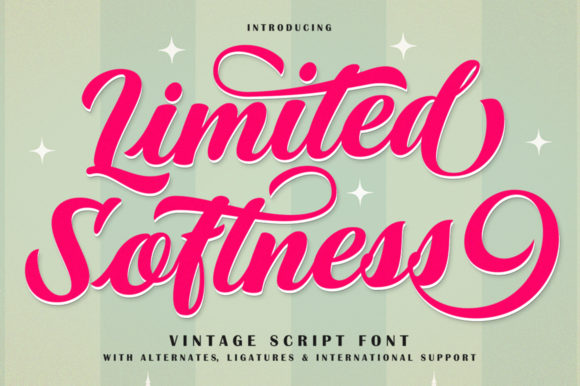
Limited Softness Font: A Beautiful Script for Creative Expression
Limited Softness is a beautiful script font that captures the essence of natural calligraphy. Its elegant swashes and flowing curves make it ideal for creative projects where visual appeal is key. Whether you're designing wedding invitations, crafting social media content, or creating greeting cards, Limited Softness adds a touch of sophistication and charm to your work.
What Makes Limited Softness Stand Out?
Limited Softness is more than just a font—it’s a design language. It features a natural calligraphy style that feels authentic and handcrafted. The soft, flowing lines and decorative swashes give it a unique character that stands out in a world of digital typography.
This font is particularly well-suited for projects that require both elegance and readability. Unlike some script fonts that can be difficult to read at smaller sizes, Limited Softness maintains clarity while still offering the artistic flair of a handwritten style. This balance makes it versatile enough to use in a variety of contexts.
Where Does Limited Softness Fit Into Your Workflow?
The integration of Limited Softness into your workflow depends on your specific needs and goals. Here are a few scenarios where this font shines:
- Wedding Invitations: Limited Softness brings a romantic and personal touch to wedding stationery. Its graceful curves and elegant swashes complement the theme of love and celebration.
- Social Media Posts: For designers and marketers, Limited Softness can elevate brand aesthetics. It works well with minimalist layouts and can help create eye-catching visuals that stand out in a crowded digital space.
- Greeting Cards: Whether for birthdays, anniversaries, or holiday greetings, Limited Softness adds a warm and inviting feel to your messages. It's perfect for creating handmade or digital cards that reflect your personality.
- Stationary Art: Artists and illustrators can use Limited Softness as part of their creative process. It can be paired with other design elements to create visually compelling compositions.
Regardless of the project, Limited Softness offers a consistent aesthetic that supports both creativity and professionalism. Its adaptability allows it to fit seamlessly into different stages of your workflow—whether you're brainstorming ideas, refining designs, or finalizing outputs.
How to Use Limited Softness Effectively
Using Limited Softness effectively requires thoughtful planning and execution. Here are some practical tips to help you integrate it smoothly into your projects:
1. Choose the Right Context: Before applying Limited Softness, consider the purpose and audience of your design. It works best in contexts where a soft, elegant look is desired. Avoid using it in situations where clarity is paramount, such as long-form text or technical documents.
2. Pair with Complementary Elements: To enhance the visual impact of Limited Softness, pair it with contrasting or complementary design elements. For example, pairing it with a clean sans-serif font can create a balanced and professional look.
3. Test Across Platforms: Ensure that Limited Softness renders well across different devices and platforms. Check how it looks on both desktop and mobile screens, and verify that it remains legible at various sizes.
4. Consider Branding Consistency: If you're using Limited Softness for branding purposes, ensure it aligns with your overall brand identity. Maintain consistency in color schemes, spacing, and layout to reinforce your message.
5. Optimize for Readability: Even though Limited Softness is designed for elegance, readability should never be compromised. Use appropriate line spacing, letter spacing, and font size to ensure your text is easy to read.
Integrating Limited Softness Into Your Creative Process
Integrating Limited Softness into your creative process involves more than just selecting a font. It's about understanding how it fits into your broader design strategy and workflow. Here are some ways to incorporate it naturally:
During the Planning Phase: When planning a project, consider how Limited Softness can enhance the visual tone. For instance, if you're designing a series of social media posts, using Limited Softness can help maintain a cohesive and stylish aesthetic across all content.
During the Execution Phase: As you begin designing, experiment with Limited Softness in different formats and layouts. Try using it in headers, subheadings, or call-out sections to see how it complements your design elements.
After the Final Output: Once your design is complete, review it for consistency and quality. Ensure that Limited Softness is used appropriately and that it enhances rather than detracts from the overall message of your work.
Factors to Consider When Using Limited Softness
When incorporating Limited Softness into your workflow, there are several factors to keep in mind:
Preparation: Before using Limited Softness, familiarize yourself with its characteristics and limitations. Understanding how it behaves in different contexts will help you use it more effectively.
Compatibility: Ensure that Limited Softness is compatible with the tools and platforms you use. Some design software may not support certain fonts, so always check compatibility before starting a project.
Usability: Prioritize usability by testing Limited Softness in real-world scenarios. How does it look in print versus digital formats? Is it readable at small sizes? These questions will help you determine whether it's the right choice for your project.
Organization: Keep your design assets organized to streamline your workflow. Store fonts like Limited Softness in a dedicated folder and label them clearly so they’re easy to access when needed.
Efficiency: Streamline your workflow by using Limited Softness consistently across similar projects. This helps maintain a cohesive brand identity and reduces the time spent switching between different fonts.
Consistency: Maintain consistency in your design choices. If you use Limited Softness for one project, consider using it again for others that share a similar aesthetic or purpose.
Quality Control: Always review your work for quality. Check for any issues related to font rendering, spacing, or alignment. Ensuring high-quality output is essential for professional results.
Long-Term Use: Think about how Limited Softness will fit into your long-term design strategy. Will it remain relevant as your projects evolve? Can it be adapted for future uses without losing its unique character?
Conclusion
Limited Softness is more than just a font—it's a tool for creative expression. Its natural calligraphy style and elegant swashes make it a valuable asset for designers, marketers, and creators looking to add a touch of sophistication to their work. By integrating Limited Softness thoughtfully into your workflow, you can enhance the visual appeal of your projects while maintaining clarity and consistency.